Yoruba Orisa Hierarchy and the Truth About Ranking Divine Forces

by Baba Esuwale Adigun (King Brujo)
There is a trend online where people attempt to rank Orisa the way people rank sneakers or NBA players. It makes for entertaining arguments, but it does not come from Yoruba cosmology. The idea of a strict Yoruba Orisa hierarchy based on superiority is not traditional. It is a projection from other religious systems trying to interpret an indigenous worldview without cultural context.
To correct this, we must first understand how Orisa are organized within creation.
Why Yoruba Orisa Hierarchy Is Not Based on Superiority
In the Yoruba worldview, Orisa are not sorted by value, holiness, or status. The culture does not ask who is highest or lowest. The culture asks how each force contributes to balance. A true understanding of Yoruba Orisa hierarchy begins with function.
In creation:
Obatala shapes form
Orunmila reveals destiny and instruction
Ori chooses purpose
Esu manages communication and balance
Ogun clears the path and makes movement possible
Osun aligns sweetness, fertility, and social harmony
Olokun governs depth, mystery, and wealth
This is not a power ladder. It is a functional system. Yoruba Orisa hierarchy refers to placement, not competition.
Recieve clarity on Ori and governing Orisa
Understanding Yoruba Cosmology Instead of Imported Hierarchy
When people ask who is higher between Obatala and Orunmila, or whether Esu is below Orunmila, they are applying a Western hierarchical lens to an indigenous system that does not operate that way. In many Western models, divinity must be arranged into higher and lower, superior and inferior. Yoruba cosmology does not use that framework.
If the ancestors believed in a competitive Yoruba Orisa hierarchy, the corpus would record it clearly. Instead the corpus records collaboration, consultation, and interdependence.
Creation Narratives and What They Reveal About Yoruba Orisa Hierarchy
The Odu Ejiogbe shows how creation unfolds. In that narrative Obatala forms human bodies. When the forms begin showing imbalance, Obatala does not decree correction. He consults Orunmila.
This moment disrupts ranking narratives. If Obatala was above Orunmila in a Western sense, there would be no consultation. Consultation reveals jurisdiction, not subordination.
Obatala governs physical formation.
Orunmila governs destiny and cosmic instruction.
The Yoruba Orisa hierarchy is functional. It is not a competition.
Orunmila and Esu and the Structure of Access and Communication
Another useful example is the relationship between Orunmila and Esu. If hierarchy was competitive like corporate or church models, Esu would not need to open the road for divination, sacrifice, or communication. Yet every Babalawo knows that nothing moves without Esu.
Orunmila reveals destiny.
Esu grants access to destiny.
Esu manages roads, balance, communication, sacrifice, and return. Without Esu there is no access and no delivery. This shows structure rather than rivalry.
Yoruba Orisa hierarchy reflects interdependence, not domination.
Ranking Orisa Is Like Ranking Human Organs
Trying to rank divine forces by superiority instead of understanding their functions is like asking whether lungs are better than kidneys. Remove either one and the body collapses.
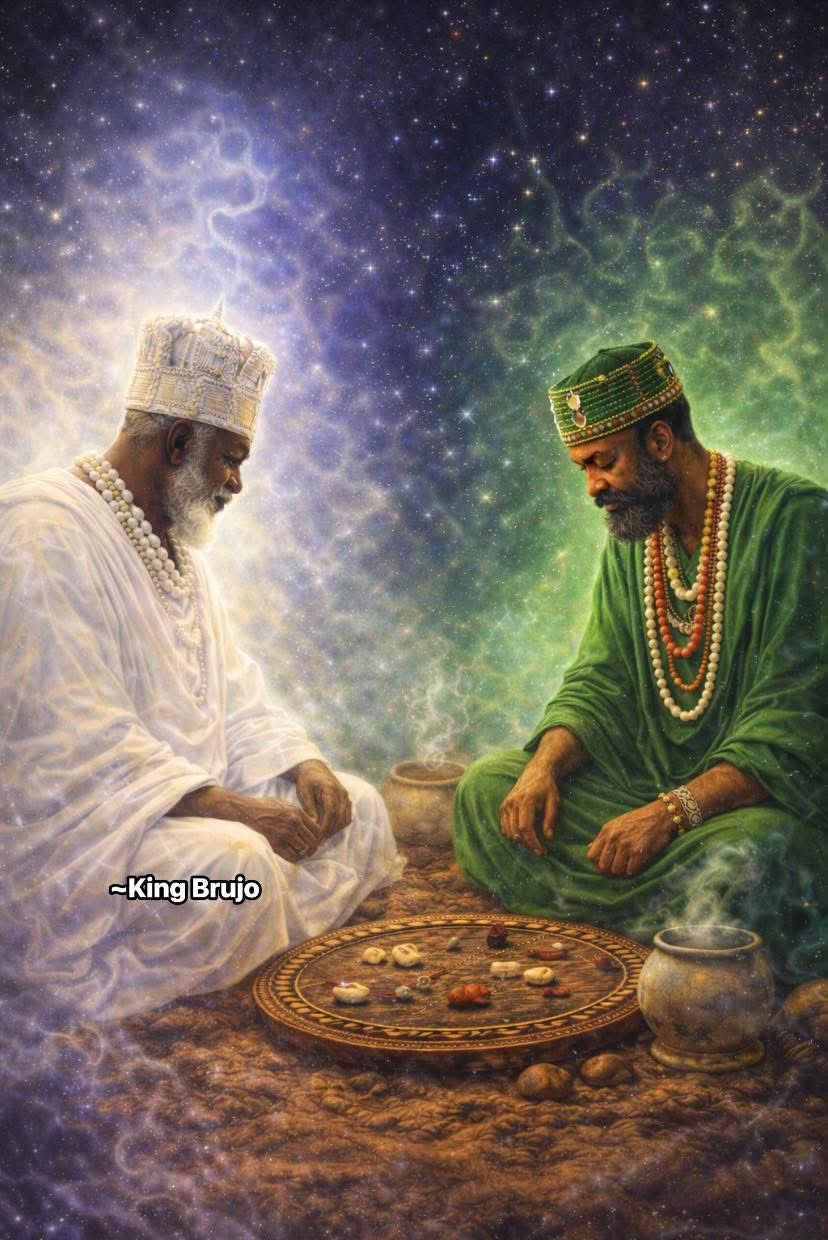
The same applies to Obatala and Orunmila, Orunmila and Esu, Ogun and Osun, or Olokun and Osun.
You only rank things that compete for the same job. No two major Orisa hold the same jurisdiction. Therefore superiority language fails immediately.
Orisa do not compete. They collaborate.
The True Yoruba Orisa Hierarchy: Placement Not Superiority
If hierarchy exists in the Yoruba system, it exists as placement, not status. Placement asks:
Who governs destiny
Who governs form
Who governs access
Who governs fertility
Who governs wealth
Who governs motion
Who governs purpose
The ancestors were clear that structure and placement matter. There is no obsession with high and low. There is concern with alignment and balance.
Spiritual maturity within this worldview is understanding placement and jurisdiction, not picking favorites or asserting supremacy.
Where Superiority Debates Really Come From
The modern superiority debate is not coming from Oyo, Osogbo, Ekiti, Ifon, or Ile Ife. It is coming from social media where Abrahamic hierarchical lenses get applied to indigenous cosmology without elders, corpus, or lineage.
In Yoruba tradition:
Structure matters
Balance matters
Function matters
Superiority does not.
The Yoruba Orisa hierarchy is a map of placement, not a ladder of winners and losers.
Orisa are not in competition. Humans are.
Conclusion: The Ancestors Already Settled the Issue
The Ifa literary corpus does not portray Orisa gathering to vote on superiority. It portrays them consulting one another, relying on one another, and working together for creation and balance.
Obatala shapes form
Orunmila governs destiny
Esu enforces balance and communication
Ogun enables motion and war
Osun harmonizes sweetness and fertility
Olokun manages depth and wealth
Ori chooses purpose
A true Yoruba Orisa hierarchy is a system of placement, not superiority.
Orisa are not rivals.
Orisa are not politicians.
Orisa are not sports teams.
They are divine functions working in cooperation.
Understanding that is the beginning of spiritual maturity.
Ready to understand which Orisa governs your spiritual identity?
Receive a private Orisa determination reading with explanation
Confidential and respectful of lineage and culture
Comments